FTC Submits Annual Budget Request to Congress

[ad_1]

The Federal Trade Commission submitted to Congress its Fiscal Year 2024 budget request, in support of the President’s FY 2024 budget for the federal government. The budget request also includes the Performance Plan for FY 2023 and FY 2024 and Performance Report for FY 2022, as required under the GPRA Modernization Act of 2010.

The Commission vote to submit the budget request to Congress was 3-0-1, with Commissioner Christine S. Wilson not participating. That staffer on the reports was James Hale in the FTC’s Financial Management Office.

[ad_2]

Source link

FTC Submits Annual Budget Request to Congress Read More »

FTC Seeks Public Comment on Franchisors Exerting Control Over Franchisees and Workers

[ad_1]

The Federal Trade Commission requests comment on franchise agreements and franchisor business practices, including how franchisors may exert control over franchisees and their workers.

In a franchise relationship, franchisees typically pay a fee in exchange for a business format or system developed by a franchisor, the right to use the franchisor’s trademark for a specific number of years, and assistance. Owning a franchise, however, comes with defined costs, franchisor controls, and contract terms.

The FTC would like to know more about how franchisors may exert control over franchisees and their workers. Specifically, the FTC is interested in how franchisors disclose certain aspects and contractual terms of the franchise relationship, as well as the scope, application, and effect of those aspects and contractual terms. 

“Amidst growing concern around unfair and deceptive practices in the franchise industry, the FTC hopes to hear from a broad range of stakeholders about how the franchise relationship is working, and how it is not,” said Samuel Levine, Director of the FTC’s Bureau of Consumer Protection. “This cross-agency effort will inform our policy and enforcement efforts as we work to ensure a fair marketplace for franchisees.”  

“It’s clear that, at least in some instances, the promise of franchise agreements as engines of economic mobility and gainful employment is not being fully realized,” said Elizabeth Wilkins, Director of the FTC’s Office of Policy Planning. “This RFI will begin to unravel how the unequal bargaining power inherent in these contracts is impacting franchisees, workers, and consumers.”

As part of the Request for Information, the FTC is asking franchisors, franchisees, current and past employees of franchisors and franchisees, government entities, economists, attorneys, academics, consumers, and other interested parties to weigh in on a wide array of issues that affect franchisees and their workers, such as:

  • franchisees’ ability to negotiate the terms of franchise agreements before signing, and the ability of franchisors to unilaterally make changes to the franchise system after franchisees join;
  • franchisors’ enforcement of non-disparagement, goodwill or similar clauses;
  • the prevalence and justification for certain contract terms in franchise agreements;
  • franchisors’ control over the wages and working conditions in franchised entities, other than through the terms of franchise agreements;
  • payments or other consideration franchisors receive from third parties (e.g., suppliers, vendors) related to franchisees’ purchases of goods or services from those third parties;
  • indirect effects on franchisee labor costs related to franchisor business practices; and
  • the pervasiveness and rationale for franchisors marketing their franchises using languages other than English.

The public will have 60 days to submit comments at Regulations.gov. Once submitted, comments will be posted to Regulations.gov.

Apart from this Request for Information, the FTC is seeking public comment on a proposed rule to ban noncompete clauses for workers in some situations. As part of that proposed rulemaking, the FTC is interested in public comments on the question of whether that proposed rule should also apply to noncompete clauses between franchisors and franchisees. Comments related to the use of noncompete restrictions in franchise agreements should be submitted as part of the noncompete rulemaking through April 19, 2023. This Request for Information is separate from the noncompete rulemaking proceeding. Similarly, this Request for Information is separate from the Franchise Rule regulatory review. Any comments submitted in response to this Request for Information will not automatically become part of either the noncompete rulemaking proceeding or the Franchise Rule regulatory review record. 

The lead staff attorneys on this matter are Christine M. Todaro and Josh Doan from the FTC’s Bureau of Consumer Protection and Alex Petros from the FTC’s Office of Policy Planning.

[ad_2]

Source link

FTC Seeks Public Comment on Franchisors Exerting Control Over Franchisees and Workers Read More »

FTC Announces Tentative Agenda for March 16 Open Commission Meeting

[ad_1]

Today, Federal Trade Commission Chair Lina M. Khan announced that an open meeting of the Commission will be held virtually on Thursday, March 16, 2023. The open meeting will commence at 11am ET and will begin with time for members of the public to address the Commission.

The following items will be on the tentative agenda for the March 16 Commission meeting:

Business Before the Commission

6(b) Orders Concerning Deceptive Advertising on Social Media: The Commission will vote on whether to issue 6(b) Orders to eight social media and video streaming platforms concerning how they monitor and review deceptive advertising on their platforms. Specifically, the Orders will examine the companies’ ad review practices and what, if any, measures they have taken to detect, prevent, and reduce deceptive advertising on their platforms, including advertising related to fraudulent health-care products, financial scams, and fake goods.

6(b) Orders Concerning Small Business Credit Reporting Agencies: The Commission will vote on whether to issue 6(b) Orders to five business credit reporting agencies concerning how they collect and report data about small businesses, and how they market their business credit reporting products. A business credit report can affect a small business in many ways, including potentially impacting the terms on which it can obtain goods, services, and equipment necessary for the operation of the business. This study will provide the public with information about an industry that has a significant impact on small businesses, but that currently has little publicly available data about it.

At the start of the meeting, Chair Khan will offer brief remarks and will then invite members of the public to share feedback on the Commission’s work generally and bring relevant matters to the Commission’s attention. Members of the public must sign up for an opportunity to address the Commission virtually at the March 16 event.

Each commenter will be given two minutes to share their comments. Those who cannot participate during the event may submit written comments or a link to a prerecorded video through a webform. Speaker registration and comment submission will be available through Tuesday, March 14, 2023 at 8 pm ET.

The FTC’s public meeting agendas will be posted on the Commission’s website at least seven days prior to the Commission’s next monthly meeting. A link to the event will be available on the day of the event, shortly before the meeting starts via FTC.gov. The event will be recorded, and the webcast and any related comments will be available on the Commission’s website after the meeting. The Commission retains discretion to make public comments available following the event on ftc.gov.

[ad_2]

Source link

FTC Announces Tentative Agenda for March 16 Open Commission Meeting Read More »

FTC Finalizes Order Against Pyrex Glass Manufacturer for False Made in USA Claims

[ad_1]

The Federal Trade Commission has finalized its order against Instant Brands, manufacturer of Pyrex-brand kitchen and home products, for making false “Made in USA” claims. The FTC’s order, first announced in January 2023, stops the company from making deceptive claims about products being “Made in USA” and requires it to pay a monetary judgment.

The FTC’s order against Instant Brands, which the company has agreed to, includes a number of requirements about the claims it makes:

The order also requires Instant Brands to pay a $129,416 judgment.

The Commission vote to finalize the order was 4-0. The lead staff attorney on this matter was Julia Solomon Ensor in the Bureau of Consumer Protection.

[ad_2]

Source link

FTC Finalizes Order Against Pyrex Glass Manufacturer for False Made in USA Claims Read More »

FTC Sends Nearly $2.4 Million to Raging Bull Customers After the Company Agrees to Settle Charges of Bogus Earnings Claims

[ad_1]

The Federal Trade Commission is sending payments totaling nearly $2.4 million to consumers who paid subscription fees to the online stock trading site RagingBull.com, a company the FTC says used bogus earnings claims to trick consumers. 

Explore Data with the FTC: Refunds

The FTC has begun sending 9,862 Paypal payments to consumers who were affected. Recipients should accept their payment within 30 days. Recipients who have questions about their payment should call the refund administrator, JND Legal Administration, at 877-415-0647, or visit the FTC website to view frequently asked questions about the refund process. The Commission never requires people to pay money or provide account information to get a refund.

The FTC sued Raging Bull and its owners in December 2020 as part of Operation Income Illusion, a nationwide law enforcement effort targeting deceptive income claims. The FTC charged that the company used bogus earnings claims to trick people into paying for investment strategies and recommendations, and then trapped them into hard-to-cancel subscription plans with costly fees. The FTC’s complaint noted that consumers who purchased the site’s services lost millions of dollars in their investments.

In March 2022, Raging Bull and its owners agreed to a settlement with the FTC that required them to pay $2.425 million, end their earnings deception, get affirmative approval from consumers for subscription sign ups, and provide them with a simple method to cancel recurring charges.

The Commission’s interactive dashboards for refund data provide a state-by-state breakdown of refunds in FTC cases. In 2022, Commission actions led to more than $392 million in refunds to consumers across the country.

[ad_2]

Source link

FTC Sends Nearly $2.4 Million to Raging Bull Customers After the Company Agrees to Settle Charges of Bogus Earnings Claims Read More »

National Consumer Protection Week 2023 Begins Sunday, March 5

[ad_1]

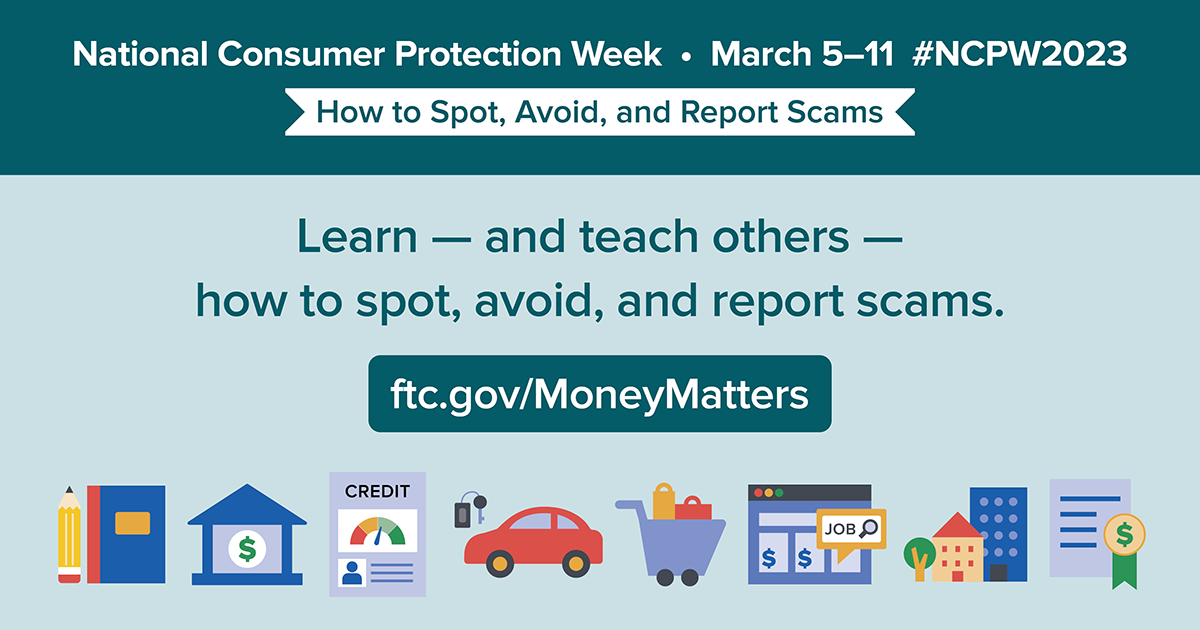
National Consumer Protection Week 2023 begins this Sunday, March 5.

The Federal Trade Commission and its partners, including consumer organizations, national advocacy organizations, and other federal, state, and local government agencies will participate in virtual and in-person events to promote consumers’ rights and protections against fraud, scams, and identity theft.

NPRM: Noncompete Infographic. An estimated* 18% of U.S. workers are covered by noncompetes.

The FTC and partners will host and participate in town halls, roundtables, Twitter chats, webinars, and other events focused on helping people understand their consumer rights and avoid fraud, scams, and identity theft. Please see the list below for details on the week to come:

All week

  • Follow the FTC on social media for quick, shareable consumer tips all week long.

Saturday, March 4, and Sunday, March 5

Monday, March 6

  • (In-person event) 10:30am EST: Join the FTC, the Georgia Department of Law’s Consumer Protection Division, and AARP Georgia for a panel discussion on identity theft and scams at the Elaine H. Lucas Senior Center at 132 Willie Smokie Glover Drive in Macon, GA.
  • 10:30am MST: Join the FTC and the Colorado Attorney General’s Office of Financial Empowerment for a virtual workshop about consumer financial protection tools from federal, state, and local government.
  • 2pm EST: Join the FTC for a special NCPW webinar about the top frauds reported in 2022, with a special focus on how they affect older adults and how to protect people from scams.

Tuesday, March 7

  • (In-person event) 10am PST: Join the FTC, Nevada Consumer Affairs, Nevada AG, and BBB for a Town Hall event at the Reno + Sparks Chamber of Commerce at 4065 South Virginia Street #101 in Reno, NV.
  • 2pm EST: Join the FTC, AARP Fraud Watch Network, and the Association of Bookmobile and Outreach Services for a virtual town hall discussion with librarians about how to spot and avoid the top scams affecting older patrons.
  • (In-person event) 1pm PST: Join the FTC and the United States Postal Inspection Service for a presentation on tax, mail, and impersonator scams and how to avoid them, at the Northshore Senior Center at 10201 East Riverside Drive in Bothell, WA.
  • (In-person event) 2pm – 4pm PST: Join the FTC for a Fraud Prevention Round Table at Mercy Oaks at 100 Mercy Oaks Drive in Redding, CA. FTC staff will discuss ways to avoid common scams. 

Wednesday, March 8

  • (In-person event) 10am – 2pm HAST: Visit the FTC table at the Department of Commerce and Consumer Affairs NCPW Fair at the King Kalakaua Building Courtyard at 335 Merchant Street, in Honolulu, Hawaii. FTC staff will give out free resources on avoiding scams and identity theft.
  • (In-person event) 10am – 1pm PST: Visit the FTC table at the Shasta County District Attorney’s Office Fraud Prevention Fair at Mercy Oaks at 100 Mercy Oaks Drive in Redding, CA. FTC staff will give out free resources on avoiding scams and identity theft.
  • 10am CST: Join the FTC and Texas Senior Medicare Patrol for a webinar about fraud against older adults.
  • 1pm EST: Join the NCPW Twitter chat @laFTC (in Spanish) for advice on avoiding common scams. Follow the conversation by using the hashtag #NCPW2023.
  • 1pm EST: Call in to join the FTC and AARP Ohio for a Tele-Town Hall about how to avoid scams.
  • 3pm EST: Join the NCPW Twitter chat @FTC (in English) for advice on avoiding common scams. Follow the conversation by using the hashtag #NCPW2023.
  • 3pm CST: Join the FTC and the City of Chicago Department of Business Affairs and Consumer Education for a webinar on top frauds and how to avoid them.
  • 5pm EST: Call in to the Cleveland WEWS News Channel 5 NCPW Consumer Phone Bank and speak with FTC staff and consumer advocates for advice on consumer issues. Tune in during the evening telecast to get the call-in number.

Thursday, March 9

  • All Day: Watch and share Instagram Reels (in English and Spanish) from the FTC and Social Security Administration on how to avoid impersonator scams.
  • 1pm EST: Join the FTC for a special NCPW webinar about how to spot and avoid the top frauds reported in 2022 with a special focus on how they affect older adults.

Saturday, March 11

  • (In-person event) 10am-11am EST: Visit with FTC and volunteer attorneys for a Legal Advice Clinic at the Cleveland Public Library, Jefferson Branch at 850 Jefferson Avenue in Cleveland, OH. Volunteer attorneys will be available to listen to listen to consumer-related and other civil issues (non-criminal) and will then offer brief advice or referrals to useful resources. Attendees will be seen on a first-come, first-serve basis.

 For information on how to get involved, visit ftc.gov/NCPW.


[ad_2]

Source link

National Consumer Protection Week 2023 Begins Sunday, March 5 Read More »

FTC Takes Action Against doTERRA Distributors for False COVID-19 Health Claims

[ad_1]

The Federal Trade Commission has brought lawsuits against three current and former high-level distributors – so-called “Wellness Advocates” – of the Utah-based multi-level marketing company doTERRA International, LLC, for making claims that the company’s essential oils and dietary supplements could treat, prevent, or cure COVID-19. The distributors, all current or former healthcare practitioners, made the claims in a series of webinars in early 2022 and touted their medical expertise in recommending the products.

“Those making baseless claims that essential oils and supplements can prevent or treat COVID-19 will pay a price,” said Sam Levine, Director of the FTC’s Bureau of Consumer Protection. “Today’s actions against doTERRA ‘wellness advocates’ should be a reminder that distributors for multilevel marketing companies can face consequences for making deceptive claims.”

The three complaints, filed by the Department of Justice on behalf of the FTC, allege that the defendants made numerous claims about the ability of various doTERRA products to prevent, treat, or cure COVID-19, in violation of the FTC Act and the COVID-19 Consumer Protection Act. The defendants are:

  • Eliza Johnson Bacot: Bacot, a nurse practitioner and doTERRA Diamond level distributor, allegedly made claims recommending doTERRA products as a way to prevent as well as treat COVID-19 infection, saying the ingredients in one product “have had some great studies behind them as far as helping with COVID, post-inflammatory response and viral replication,” and that another product could help prevent or treat long  COVID-19 “because of the oils in there like tangerine and cilantro, which help the body detox and also repair.”
  • Lauren Busch: Busch, a former registered nurse and doTERRA Diamond level distributor at the time of the webinars, allegedly made claims that doTERRA products are part of “protocols that have been found to be completely effective and amazing by practitioners who are actually working with patients who are struggling right now and that they have been very successful with…,” and that there is “amazing research on essential oils that inhibit the SARS-CoV-2 spike protein” relating to chemical compounds that are “in several of our oils.”
  • Dr. Tina Wong: Dr. Wong, a California pediatrician and doTERRA Blue Diamond level distributor, allegedly discussed specific doTERRA products as part of “COVID prevention basics” and “pediatric prevention/support for COVID.” She also claimed that “…there’s lots of studies that show that oregano is effective against a coronavirus, which is the family that COVID is in,” and that “…lemon and geranium essential oil inhibit the mRNA transcription of the virus.”

The defendants have agreed to court orders that will require them to:

  • Stop making unfounded COVID claims: The orders prohibit the defendants from making any claims that a product can prevent, cure, or treat COVID-19 unless the Food and Drug Administration has approved the claim.
  • Back up any health claims: The orders require the defendants to have reliable human clinical testing to support claims about other diseases, require them to have scientific proof for any other health claims they make, and prohibit them from mispresenting that a product’s benefits are scientifically or clinically proven.
  • Pay a $15,000 financial penalty: Each defendant will be required to pay a $15,000 civil penalty.

The Commission vote to authorize the staff to refer the complaints to the DOJ and to approve the proposed consent decrees was 4-0. The DOJ filed the complaints and proposed consent decrees on behalf of the Commission in U.S. District Court as follows: in the Northern District of Georgia against Bacot; in the District of Utah against Busch; and in the Central District of California against Dr. Wong

The FTC staff attorneys on this case are Christine DeLorme and Tiffany Woo of the Bureau of Consumer Protection.

NOTE: The Commission authorizes the filing of a complaint when it has “reason to believe” that the named defendants are violating or are about to violate the law and it appears to the Commission that a proceeding is in the public interest. Consent decrees have the force of law when approved and signed by the District Court judge.

[ad_2]

Source link

FTC Takes Action Against doTERRA Distributors for False COVID-19 Health Claims Read More »

FTC to Ban BetterHelp from Revealing Consumers’ Data, Including Sensitive Mental Health Information, to Facebook and Others for Targeted Advertising

[ad_1]

The Federal Trade Commission has issued a proposed order banning online counseling service BetterHelp, Inc. from sharing consumers’ health data, including sensitive information about mental health challenges, for advertising. The proposed order also requires the company to pay $7.8 million to consumers to settle charges that it revealed consumers’ sensitive data with third parties such as Facebook and Snapchat for advertising after promising to keep such data private.

This is the first Commission action returning funds to consumers whose health data was compromised. In addition, the FTC’s proposed order will ban BetterHelp from sharing consumers’ personal information with certain third parties for re-targeting—the targeting of advertisements to consumers who previously had visited BetterHelp’s website or used its app, including those who had not signed up for the company’s counseling service. The proposed order also will limit the ways in which BetterHelp can share consumer data going forward.

“When a person struggling with mental health issues reaches out for help, they do so in a moment of vulnerability and with an expectation that professional counseling services will protect their privacy,” said Samuel Levine, Director of the FTC’s Bureau of Consumer Protection. “Instead, BetterHelp betrayed consumers’ most personal health information for profit. Let this proposed order be a stout reminder that the FTC will prioritize defending Americans’ sensitive data from illegal exploitation.”

California-based BetterHelp offers online counseling services under several names, including BetterHelp Counseling. It also markets services aimed at specific groups such as Faithful Counseling focused on Christians, Teen Counseling, which caters to teens and requires parental consent, and Pride Counseling, which is targeted to the LGBTQ community. Consumers interested in BetterHelp’s services must fill out a questionnaire that asks for sensitive mental health information—such as whether they have experienced depression or suicidal thoughts and are on any medications. They also provide their name, email address, birth date and other personal information. Consumers are then matched with a counselor and pay between $60 and $90 per week for counseling.

At several points in the signup process, BetterHelp promised consumers that it would not use or disclose their personal health data except for limited purposes, such as to provide counseling services. Despite these promises, BetterHelp used and revealed consumers’ email addresses, IP addresses, and health questionnaire information to Facebook, Snapchat, Criteo, and Pinterest for advertising purposes, according to the FTC’s complaint

For example, the company used consumers’ email addresses and the fact that they had previously been in therapy to instruct Facebook to identify similar consumers and target them with advertisements for BetterHelp’s counseling service, which helped the company bring in tens of thousands of new paying users and millions of dollars in revenue.

According to the complaint, BetterHelp pushed consumers to hand over their health information by repeatedly showing them privacy misrepresentations and nudging them with unavoidable prompts to sign up for its counseling service. Despite collecting such sensitive information, BetterHelp failed to maintain sufficient policies or procedures to protect it and did not obtain consumers’ affirmative express consent before disclosing their health data. BetterHelp also failed to place any limits on how third parties could use consumers’ health information—allowing Facebook and other third parties to use that information for their own internal purposes, including for research and development or to improve advertising.

BetterHelp also misled users and the public in 2020 by falsely denying news reports that it revealed consumers’ personal information, including their health information, with third parties, according to the complaint.

The $7.8 million that BetterHelp must pay under the proposed order will be used to provide partial refunds to consumers who signed up for and paid for BetterHelp’s services between August 1, 2017, and December 31, 2020. In addition to banning BetterHelp from disclosing health information for advertising, the proposed order also prohibits the company from misrepresenting its sharing practices and requires it to:

  • obtain affirmative express consent before disclosing personal information to certain third parties for any purpose;
  • put in place a comprehensive privacy program that includes strong safeguards to protect consumer data;
  • direct third parties to delete the consumer health and other personal data that BetterHelp revealed to them; and
  • limit how long it can retain personal and health information according to a data retention schedule. 

The Commission voted 4-0 to issue the proposed administrative complaint and to accept the consent agreement with the company. Commissioner Christine S. Wilson issued a concurring statement.

The FTC will publish a description of the consent agreement package in the Federal Register soon. The agreement will be subject to public comment for 30 days after publication in the Federal Register after which the Commission will decide whether to make the proposed consent order final. Instructions for filing comments will appear in the published notice. Once processed, comments will be posted on Regulations.gov.

NOTE: The Commission issues an administrative complaint when it has “reason to believe” that the law has been or is being violated, and it appears to the Commission that a proceeding is in the public interest. When the Commission issues a consent order on a final basis, it carries the force of law with respect to future actions. Each violation of such an order may result in a civil penalty of up to $50,120. 

The lead staff attorneys on this matter were Miles Plant, Manmeet Dhindsa and Ryan Mehm from the FTC’s Bureau of Consumer Protection.

[ad_2]

Source link

FTC to Ban BetterHelp from Revealing Consumers’ Data, Including Sensitive Mental Health Information, to Facebook and Others for Targeted Advertising Read More »

FTC to Host Workshop on “Recyclable” Claims as Part of its Ongoing Review of the Agency’s Green Guides

[ad_1]

The Federal Trade Commission will host a workshop on May 23, 2023, in Washington, DC, to examine “recyclable” adverting claims as part of its recently announced review of the Guides for the Use of Environmental Marketing Claims, commonly known as the Green Guides. The workshop, Talking Trash at the FTC: Recyclable Claims and the Green Guides, is free and open to the public, and pre-registration is not required.

The Commission’s Green Guides help marketers avoid making environmental marketing claims that are deceptive under Section 5 of the FTC Act. The FTC is currently reviewing the guides to determine whether updates are necessary. They were first issued in 1992 and were revised in 1996, 1998, and 2012, and provide guidance on environmental marketing claims, including how consumers are likely to interpret particular claims and how marketers can substantiate these claims to avoid deceiving consumers.

According to the Federal Register notice, the half-day event will cover topics including: the current state of recycling practices and recycling-related advertising in the United States, consumer perception of current and emerging recycling-related claims, and the need for any updates or other changes to the Green Guides related to recycling claims. The event likely will include panels on these subjects, and a more detailed agenda will be published in the coming months.

The workshop will be held at the Constitution Center in Washington, DC, from 8:30 am to 12:30 pm ET, in the first-floor conference room. It also will be available for viewing live on the internet. Written comments related to the issues to be discussed at the workshop must be received by June 13, 2023. Information about how to submit comments can be found in the notice.

The Commission vote approving publication of the Federal Register notice was 4-0. It will be published in the register shortly. The lead staffers on this matter are Hampton Newsome and Julia Solomon Ensor in the FTC’s Bureau of Consumer Protection.

[ad_2]

Source link

FTC to Host Workshop on “Recyclable” Claims as Part of its Ongoing Review of the Agency’s Green Guides Read More »

FTC and CFPB Seek Public Comment on How Background Screening May Shut Renters out of Housing

[ad_1]

The Federal Trade Commission and the Consumer Financial Protection Bureau (CFPB) are requesting comment on background screening issues affecting individuals who seek rental housing in the United States, including how the use of criminal and eviction records and algorithms affect tenant screening decisions and may be driving discriminatory outcomes.

Renters are facing a range of challenges, from rising rents to a shortage of affordable rental housing. The FTC and CFPB are seeking information on background screening practices and their potential effect on people’s ability to obtain rental housing as part of a whole-of-government effort to address these issues.

“No one should be shut out of housing because of inaccurate or unfair background screening practices,” said Samuel Levine, Director of the FTC’s Bureau of Consumer Protection. “We are proud to be part of a whole-of-government effort to ensure fairness and equity in the rental market, and we are looking forward to hearing from the public on this vital issue.”

“Error-ridden background checks are increasingly used by corporate landlords to deny housing to Americans,” said Rohit Chopra, Director of the CFPB. “We will continue to work together to protect the integrity of our credit reporting system from sloppy background check companies.”

As part of the Request for Information , the FTC and CFPB are asking current tenants, prospective tenants, advocacy groups, commercial and individual landlords, property managers, background screening companies, other consumer reporting agencies, and others to weigh in on a wide array of issues that affect tenant screening such as:

  • how criminal and eviction records are used by landlords and property managers in making housing decisions;
  • how potential inaccuracies in criminal and other records affect rental housing decisions;
  • whether consumers are informed about the criteria used in tenant screening or notified about what information in their background check led to their rejection;
  • how landlords and property managers are setting application and screening fees;
  • how algorithms, automated decision-making, artificial intelligence, or similar technology are used in the tenant screening process; and
  • whether there are ways to improve the current tenant screening process.

The FTC and CFPB are working closely to identify practices that may unfairly prevent consumers from obtaining and retaining housing, and comments to the RFI will help inform enforcement and policy actions under each agency’s jurisdiction. The Fair Credit Reporting Act, which the FTC and CFPB both enforce, also imposes requirements on many aspects of the tenant screening process. 

The public will have 90 days to submit comments at Regulations.gov. Once submitted, comments will be posted to Regulations.gov.

The lead FTC staff attorneys on this matter were Whitney Moore, Amanda Koulousias and Jarad Brown from the FTC’s Bureau of Consumer Protection.
[ad_2]

Source link

FTC and CFPB Seek Public Comment on How Background Screening May Shut Renters out of Housing Read More »

Scroll to Top